Thursday, March 12, 2015

What were you doing when you were 22?

When my daughter turned 22,  I gave her a book entitled When They were 22, 100 Famous People at the Turning Point in Their Lives.

On the cover page I wrote her a note with the day's date and noted some of her significant events and accomplishments: college graduation a month away, recent induction into Phi Beta Kappa, squad leader in The Ohio State University Marching Band, engaged to be married.

The book is a fascinating biographical look at famous people at 22 and how for each one how that age was a turning point in their lives.

Dr. Seuss took the pseudonym we all have learned to love, quit Oxford to pursue his love of drawing and cartooning delightful characters and met the women who would become his wife.

Robert Redford took a theater course in New York that changed his life's course after years of odd jobs of dishwashing, quitting school and hard drinking.

Sandra Day O'Connor took her first attorney job as a deputy county attorney in California setting in motion her long public legal career.  Despite finishing Stanford's law school in just two years and graduating third in her law class, she had been unable in the male-dominated legal world of the 1950's to get offered any attorney job offer in the private sector.  Her public sector work set in motion her lifelong work in public service.

The one or two-page vignettes about each celebrity from a variety of walks of life such as politics, acting, education, literature emphasize the turning points that occurred for each at 22.


What would they write about you at 22?  Was it the turning point in your life?

Looking back at my life, certainly 22 was a turning point for me.  I had graduated from The Ohio State University with a teaching degree in English Communications and took my first teaching job at Centerburg High School, a small rural high school at that time.   I taught a variety of semester English courses to students in grades 9-12, including British Literature and Death in Literature.

Also the school newspaper adviser, I was only four years older than my seniors and was mistaken by many of the staff and cafeteria workers for a student, being asked for hall passes and being sent to the back of the cafeteria line for "ditching" the line.

At 22 on my state minimum teaching salary of $7400 per year, I cleared $195 on my paycheck twice a month.  I had my first apartment rent of $140 to take out of the first check and $135 car payment out of the second check.  Yes, I lived on $115 a month and still had groceries and utilizes to pay for.

And the significance in my life at 22?  In my heart and in my mind I knew that teaching would be my career.  Even more than that.  My calling in life. What I would live to love to do.  Each day I drove the 25 miles to Centerburg from my tiny apartment in Westerville and back, I was genuinely happy.

I was amazed by these wonderful students and their families, honored to be their teacher.  I loved creating a special classroom culture and climate and spending days with students teaching reading, writing, and literature.  But more importantly I could not picture myself doing anything else with my life.

And I haven't.  This is my 30th year in education and my life has been changed by thousands of students, fellow staff members and families.  And to think it all started at 22.


Wednesday, March 11, 2015

Life gets better


Graphic courtesy Page-a-Day Calendar

This morning on TV I saw a Prudential commercial on a visual survey they had conducted with a group of adults from across the country.

Utilizing sticky notes of two colors, they asked people to look back at the last 5 years and write significant events in their lives.  Yellow was for positive events and blue was for negative events.

The subjects then put the notes on a huge board.

When the researchers looked at the results, they noted about an equal number of positive and negative life events noted.

They then asked the participants to look ahead at the next 5 years and do the same thing, this time speculating on the good things or bad things that would happen in their lives.

And the research was far different.

Overwhelmingly, the post-it notes were positive. In fact, almost unanimously.

It seems that even in a cross-section of people, the vast majority were optimistic about their next five years, choosing to focus on what was going to be good in their lives rather than on negatives.

Now in the commercial, the sponsors's conclusion to the participants was that while it is great for people to think about mostly good things in the future, it would be more practical to also anticipate some negative things to better prepare.  Obviously this conclusion  is related to the fact that they sell insurance.

Personally I am disappointed by their conclusion.  For those of us who work with high schoolers, we can see that one of the hardest aspects of life is convincing them that Life Gets Better.

They are often so worried about so many upcoming stressors or anxiety about the future, that it is comforting to me to see that their results confirm what the majority of educators truly believe.  When given free choice, adults choose to believe that there will be far more positives in the future than negatives.

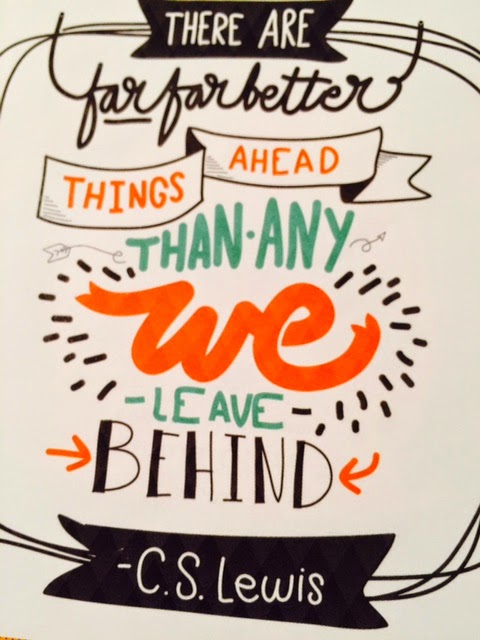
I celebrate the survey.  It is gratifying and comforting to know that as we age, just as CS Lewis stated, we fervently embrace and believe that our lives will have far better times and things ahead than what is in our past.

Now we just  need to continue, as all good educators do, to work to  convince our students, particularly the most fragile and at-risk, that life indeed does get better.


Tuesday, March 10, 2015

PLC: Putting vision into action

"Closing the Knowing-Doing Gap"-- Richard DuFour

We have been on a Professional Learning Community journey for all 11 years Dublin Jerome has been open.  When staff, students, and parents come together to create a new high school, a huge undertaking, it would be easy to be fragmented by many good ideas.

The year before we opened, we spent the time in the homes of our families-to-be, on the coffee circuit as you will.

We brought updated photos of the building under construction, and the families brought questions and provided input.

What kind of a high school did they want?

Our parents stated clearly that they wanted a high school that was "good" in a hurry.  Many of them had juniors transitioning, juniors firmly entrenched in the other two district high schools with which they were already quite happy.  The transitioning students were part of successful sports programs, stellar performing arts programs, and strong academics.

These parents were concerned because at that point, we had no credibility.  No school profile.  No average AP scores.  No average ACT scores. No good athletic programs and certainly no outstanding arts.

How good could we become in a short amount of time?

At one very formal coffee, the host had provided parents with note cards on which to write their question(s) and parents took turns as we sat in high stools on a massive patio.  I remember two clear questions from that evening:

1. What is your vision for Dublin Jerome?  An interesting question.  At first I tried answering it noting that we would bring stakeholders together to form our vision, etc.  But the parent interrupted me and clearly stated:  No, I want to know YOUR vision.

I thought a minute and then clearly articulated my vision:

One of the very best high schools in the world by numerous external indicators that indicated students learn at exceptionally high levels.

A Blue Ribbon high school on our very first five years of data.

A high school employing the best research in the world on focusing for learning for every student, every class period, by every teacher, every day: Professional Learning Communities.  I spoke very passionately about this research, for we had started it with a small and committed group of staff at the high school many of us were now leaving.  In particular how teachers collaborated in teams on the 4 questions of a PLC in order to focus on learning, rather than teaching.  How learning was the constant instead of learning.

A high school where teams of educators from local, state, national and international educational systems come to visit to see how we do business.

After rattling these things off the parents nodded and sat quietly.  I inwardly thought for a moment --what did I just do?  I had never articulated this vision aloud before but I knew in my heart that this was the school we could and would create.

After the meeting, one parent came up and told me she had contacted her brother, an educator in Illinois about the opportunity to ask us questions about her son's new high school.

She said she was so pleased to hear that we were utilizing DuFour, DuFour and Eaker's research on PLC work.  Her brother had told her that if we did not mention it, she should be very disappointed.

But she was not, and after articulating clearly the Jerome vision and seeing our parents' eyes, I knew we could do it, as that is what they wanted also.

And though PLC work is very often two steps forward and one step back, and certainly sounds easier then it looks, we have fulfilled that steps of that vision, and continue to work on it every day.

PLC is our focus and the reason for our success.  Blue Ribbon School?-- yes and with our first five years of data.  One of the top PLC schools in the nation?  Yes- a National Model PLC at Work School.  Visits from educators from all of the world?  Yes, thanks to partnerships with Battelle for Kids, we have hosted visitors from our state, nation and world, including some of the best school systems globally , China and Finland.

PLC work is not a destination, and we still have to work at it hard every day.  But the vision of being the best school for students still drives our decision-making. PLC work has made the difference for us and it can for you.

What is the Knowing-Doing Gap? DuFour and Eaker have both written about this subject, both in On Common Ground and in blog posts.  In thousands of schools across our country and world, we know what makes those practices and re-culturing needed to make the difference in student learning (the knowing) but we don't always implement the changes we need in order to change from a school focused on teaching to a school focused on learning (the doing).

It is this gap that separates PLC schools from the rest, and while the work is challenging and requires a growth mindset and stretch culture, it changes the lives of staff, parents and students.

And isn't that why we exist? Should that always be our vision?


Monday, March 9, 2015

Flu season over? I don't think so.

Got a flu shot.

Avoided feeling really lousy in a building that almost 1700 come into every day.  And yes, truly believed that despite the stats on the effectiveness of the flu vaccine I was home-free.  Feeling great.  Footloose and fancy free.

And then my secretary came to work with a high fever, leaving early last Thursday.  And yes, she touches everything of mine.

Friday, started feeling bad. Even went to doctor to get out in front of it.  Even took flu test-- now that is fun, having someone poke a long wooden stick up your nose to your brain.  Test: negative.
Felt better with an antibiotic Sat and Sunday.

Woke up this morning feeling lousy, as my Dad used to say.

Gutted it out and now am home.

Fever.

Chills.

Muscle aches.

Bad cough.

Yep.

I am not a doctor, but I can assure you that I definitely have the flu.

Crap.


Sunday, March 8, 2015

On top of every mountain . . .

"On top of every mountain, there was a great longing for another even higher mountain."

Our high school has been open for 11 years, and has been in pursuit of excellence in academics, athletics, the arts and in all areas ever since.  "We are what we repeatedly do.  Excellence, then, is not an act but a habit.  And we have enjoyed much success.

One of our successful programs has been our Hockey Team, a great family led by a coach highly committed to not only teaching students how to excel at hockey but how to excel in life with character.

Yesterday, they played for the District Championship, with the winner earning a trip to the Frozen 4.

Even making it to the District Final is an achievement for any team, as the Elite 8 in itself is the top of the mountain for many teams.

Indeed, our team had previously been there three times in the past 10 years, certainly an achievement for a young program.

Yes, all three times we have been to this mountain in the past we were thrilled to have the opportunity to make the Elite 8 and play for the chance to go to the Frozen 4.

And each time previously, we lost.  Not just lost, but lost in sudden death Overtime.

One championship game we lost in 4 OT's.

And each of the times we came away from that game we kept longing for the "even higher mountain."

It is not enough to make the one mountain if there is a higher mountain out there.

Ask any competitor who has finished runner-up what it means.  There is a huge gulf, indeed huge longing, when you reach one mountain and another higher one is still there.

In high school sports, in college sports, in pro sports-- no one is satisfied with making it to the top of just one mountain.  And I have been on both sides as a high school principal and as an Ohio State fan.  And I have looked into the eyes of outstanding student-athletes devastated because there is another mountain higher that they haven't reached, and not satisfied because they have reached one.  Even if life, no one truly is buoyed by being told we are the #2 candidate or choice.

And so, yesterday we took a 1-0 lead only to have the other team score 2 goals in 90 seconds of play.

With both teams battling hard, we carried a 3-2 lead into the third period, only to have the other team score in the first 30 seconds of the third period to tie it up.

And so it remained until the end of the third period.

Yes, our 4th time in the district final, and our 4th overtime.  We couldn't believe it.  What are the odds-- most likely greater than we think with two of the top Div. 1 teams in Central Ohio fighting hard.

Sudden death.  Teams racing up and down the ice.  Saves by both goalies.  Intense grappling for the puck.

And then it happened.  One of our players intercepted a pass, and falling down, passed it to a teammate who buried it high in the net.

Bedlam.  Gloves flying off.  Sticks sliding across the ice.  Players hugging, crying, high-fives! Our student section erupting; proud parents capturing the joy with cell phones posed! Alumni players looking wistfully at the ice.


Our players celebrate their District Championship and trip to the Frozen 4!
We had longed for the higher mountain, and we had climbed it!  The Frozen 4!

The top of the mountain.  And now the longing for another even higher one-- a different one.

Just as in life.


Saturday, March 7, 2015

The time to be happy is now, the place to be happy is here

"The time to be happy is now, the place to be happy is here, the way to be happy is to make others so."

Do you know anyone who will be happy tomorrow?  You know, as in "when I graduate from high school and get on my own I will be happy."

When I get to college I will be happy.

When I get the job I want -- that will make me happy.

When I get married I will be happy.

When I have children, I will be happy.

When I become a manager or supervisor I will be be happy.

When I get the bigger and better job I will be happy.

When I retire I will be happy.

Do you have a baby?  Maybe a young child.  Are you always wishing for them to be in the next stage?  You know, sleeping thought the night, out of the terrible two's, out of daycare, out of preschool, out of elementary, out of high school . . . And before you know it you have wished away every stage.

There are so many quotes to remind us to not only live in the moment but to enjoy it, love it.  Carpe diem.  Seize the day. Once a minute is gone we can never get it back.

But for many it is impossible to do.

Sometimes we have a tendency to play the victim, and so we defer our happiness.  We start imagining those perfect times in our lives when we will finally be happy.

And then, just as fast as a baby becomes an adult, the days blur by and happiness never comes for some.

The time to be happy is now.  The place to be happy is here. The way to be happy is to make others so.

It is the last part of that quote that is the key.  If we focus on making others happy, then we move off all of the reasons or things in our lives that make us unhappy.

I am lucky.  I have had this quote in front of me for at least the last 30 years.  I have posted it in every classroom I had when I was a teacher, in every office as a principal, and in my wallet.

It has been a wonderful reminder to serve others, every day.  And in doing so, I have learned to never wish away even one day,  even the very difficult ones.  I have loved every day and every stage of my daughter's life, and still do now that she is an adult.  It is such a blessing to be a mother, to be a wife, to have been a teacher, and to be a principal.

I have loved every classroom I had the privilege to hold the hopes and dreams of my students and my families, and I have loved every day of being a principal. even the tragic ones.

For if we can continue to serve others, and make their lives better by living in the moment, the good ones and the bad, then we don't wait for the next minute, hour, day or the next stage of our lives to be happy.

"The time to be happy is now, the place to be happy is her, and the way to be happy is to serve others."

What a wonderful way to live life!


Friday, March 6, 2015

Can'ts into cans; dreams into plans

Artwork courtesy of Page-A-Day Calendar

Our high school is an International Baccalaureate (IB) World School. Starting overseas, the  IB Diploma Program is considered to be the most rigorous curriculum in the world.  Colleges and universities, especially those with selective admissions, weight high school students earning the IB Diploma more heavily than any other admission criteria.

In their Junior and Senior years, IB Diploma candidates take courses in six subject areas: Language and Literature, Language acquisition, Individuals and Societies, Science, Math and Arts.

At our school, all IB courses are weighted on the 5.0 scale.  In addition, students are required to take Theory of Knowledge, a course that explores the reflection and nature of knowledge; a 4000-word Extended Essay based on a student-driven research project; and a Creativity, Action, Research (CAS) Project, requiring a 3-part emphasis requiring teamwork, personal challenge and reflection.

If it sounds difficult it is.  Ask yourself this question-- if you were a high school student would you choose this amount of work your junior and senior year?

At our school, and at schools around the world, students choose to challenge themselves every day.  Their IB assessments, rigorous examinations mailed to trained IB graders in India, New Zealand, China, Australia and all around the globe are essay-based, requiring deep interdisciplinary thinking, and no multiple choice items that characterize American assessments, including Advanced Placement.

Why do students choose IB?  Are these students only the "brainiacs" of our high school and other global high schools?

The answer is an unequivocal no.  Many of these students are our most unassuming students.  Bright? Yes. Hard-working?  Absolutely yes.  Dedicated to making the world better by examining content from a global perspective?  You bet.

But truly the reason these students are IB Diploma students are because they turned the can'ts into cans.  While other students found reasons NOT to do the IB Diploma these students didn't.  Why?  Because they have dreams, of college and of life, and the IB Diploma is an excellent way of turning their dreams into plans.

Our IB Diploma candidates hold a CAS (Creativity, Action, Service) Demonstration evening to explain and display their CAS projects.  What an amazing evening!

IB Diploma Program candidate explains her CAS project.
One student proudly showed her 4 State Championship (yes, 4!) golf medals, another her Mid-Ohio Food Bank volunteerism and another his youth league participation.  All of the projects demonstrated their creativity in a range of activities, including making jewelry, designing a website or in cooking, a variety of community service projects, and team pursuits ranging from the arts to athletics.

They completed these projects while taking six academic IB courses and TOK and don't forget their 4000-word Extended Essays.  And those rigorous Internal and External exams are stressful!

Could they have found many reasons NOT to be an IB Diploma candidate. Sure.  Do other students? Yes.

But our IB Diploma candidates and graduates are the ones who turn their can'ts into cans and dreams into plans.