If you are like most high school principals as I am this time of year, your students are very likely to either be taking exams this week or soon after Winter Break.
For us, Tuesday - Friday is exam time, with Periods 1-2 on Tuesday, periods 3-4 on Wednesday, periods 5-6 on Thursday and period 7 on Friday. Students take two exams per day, and preceding each exam is a preparation period with their teachers.
If you are a professional learning community as we are, does your exam week look different then for students and staff within this schedule?
Yes. For our students who have tiered privileges and incentives based on their grade level and their earned letter grades, only junior and seniors who have A's, B's and C's cumulatively for their first semester have earned the privilege of coming and going during exam week. All juniors and seniors who have a D or F cumulatively are required to attend exam week in its entirety. When they are not taking an exam the students report to the cafeteria where content lab teachers have duties based on the teacher exam schedule. Students are required to choose a subject area, most likely the area of their D and F, and teachers provide targeted academic help and support.
Freshmen and sophomores have not yet established a successful history of exam success, and they are also required to attend exam week in its entirety. These students are also able to receive academic support from content area teachers when they are not scheduled for an exam.
What about the impact on staff? Staff members value requiring students to receive extra time and support for learning during exam week and they turn in these students' names to our Attendance Office so that the students required to be here stay. They also inform the students of who has lost the privilege of coming and going.
What else is different during exam week for us? All exams are common exams except those singletons, and since our district has three high schools, some of the exams are district-common and some are building-common.
What does your analysis for your exam data tell you? We carefully track the percentage of students who receive D's and F's on exams, as we do at Interim and Quarterly. We have found that our quarterly grades are historically higher than exam grades and looked at various reasons.
When we engaged our students in these discussions, we found that even on same-subject teams that gave common exams were engaging in different exam preparation strategies. In other words, some students all in English I or Biology, for example, were getting different review practices depending on their teachers. We also examined post-exam practices, and found that teachers who developed common exams were also employing very different follow-up strategies with our students. While some teachers utilized exams as formative for the second semester, some barely followed up at all with students on their performance.
In addition, we also looking this year at how each same-subject team is utilizing the class period prior to each exam, as we believe the teacher and student usage of this time also affects our exam data. We are continuing to work every day to not only improve our common assessments, but also to improve our exam preparation and follow-up, so that every student has an opportunity to do his/her best on assessments every day, and during exam week.
Sunday, December 14, 2014

Wednesday, September 24, 2014
PLC: Systemic Response to a Learning Emergency
In many high schools, this week is Interim Week, the week where students and parents are informed about student progress halfway through the grading period.
At Dublin Jerome High School, a National Model Professional Learning Community at Work School and National Blue Ribbon School, not only do we communicate student progress, we act on it.
Do you carefully monitor student progress regularly? We do-- at the middle and end of four quarterly grading periods per year. More importantly, do you act on the D's and F's that individual students receive? For us, it is a learning emergency. And emergencies need immediate attention.
Here are the series of steps that we take as a Professional Learning Community to provide mandated intervention for students who need additional academic support to be successful:
1. We run a D and F report by grade level, by individual student and by individual teacher. This allows for data analysis for academic trends as well as identifying individual academic concerns. Both the grade level data and individual student data is provided to every staff member.
2, Teachers submit grades electronically and then determine which students with D's or F's receive a Gold Card ( named after one of our school colors). A Gold Card outlines mandated intervention procedures for students. Teachers meet with each of their Gold Card students and explain the procedures, which include a student getting 8 signatures that verify the extra academic support the student seeks and receives. The responsibility then lies with the student. The teacher issuing the card is the first signature and the last signature, signifying it is complete within 4.5 weeks. Students who receive a Gold Card but seek no assistance meet with an administrator and receive school discipline for insubordination.
3. Teachers send the names, grade level, subject and letter grade to a guidance secretary. Guidance Counselors, with case loads by alphabet, individually meet with every Gold Card student and also initial the card, ensuring students understand how to get academic intervention according to our pyramid of interventions. Counselors also inform students with a Gold Card of a loss of privileges.
4. Students who receive a Gold Card are subject to a loss of privileges. For examples, seniors with early release or late arrival forfeit that privilege with a Gold Card for at least 4.5 weeks. A section of study hall is built by our registrar so that the period 1 and period 7 study halls account for these new study hall students with attendance.
5. Students with Gold Cards must make arrangements either with their teachers before or after school or during planning time or lunch, or with academic content lab duty teachers to get extra academic intervention with the goal of achieving learning goals, including raising their grades to all A's, B's and C's.
In addition, students with all A's. B's and C's at Interim receive a sticker on their ID every interim and end of the grading period denoting that they have earned special privileges such as being able to leave study hall and go to a number of specially designated comfortable seating areas around the building.
Student success drives every decision we make and a D or F signals a learning emergency that necessitates a systemic response by a number of staff members. Intervention by invitation doesn't work. How do you respond when a student is not learning?
Wednesday, September 10, 2014
Want more student involvement? Try student leadership
As educators we all know that research states that student involvement increases the likelihood of student success and achievement. If you are a principal as I am, you have probably spent time communicating to your staff, your parents, and more importantly, your students, about the importance of becoming involved and staying involved in extracurricular activities.
Why? Because students can list it on their resumes for college applications? Hardly. We know that we want students to become involved in clubs or organizations because students can practice forming strong relationships with other students and adults, develop important organizational and leadership skills, and yes, become better people, And isn't that our larger goal? If we develop academic success data but fail to create better people who can change other lives is that really an education? No.
As Aristotle said, "Educating the mind without educating the heart is no education at all."
But having principals or teachers make announcements encouraging students to "become involved" is largely ineffective. We can encourage, but student voice and encouragement is much more powerful. We have found this out through trial and error and many other tries at encouraging student involvement, most of which were barely effective at best.
That is why today was another amazing day at Dublin Jerome. Why? Because our student leaders organized a Club Fair attended by hundreds of students during all three of our lunch periods.
These student leaders are our Celtic Advisory Program (CAP) mentors, part of our freshman transition program leaders, who first notify teachers via their advisers' school email the date and location of the Club Fair.
As part of the email, they sent out a template for the adviser to pass along to their club or organization's officers or student leaders. The template serves as a model for a half-page handout each organization distributes at the club fair to interested students. It lists the club name, adviser, basic purpose of the club, meeting information etc.
Advertised to all parents and students through social media, enewsletters and announcements, the Club Fair is open to every students during his/her lunch period. Students leaders also make announcements in the cafeteria during all three lunches. Although the CAP mentors specifically work with freshmen in freshman advisory periods, all students can enter the gym which is completely rimmed by tables and various club displays manned by enthusiastic student leaders.
Official clubs and unofficial interest clubs have sign-up sheets and exhort students using baked goods, interactive displays, and candy to sign up for their clubs. Good-natured competition and fun embody the Club Fair culture and climate, with smiles all around.
Students leading students, students helping students. And in doing so, student grow into better people, And in the end, that is really what education is really about.
Why? Because students can list it on their resumes for college applications? Hardly. We know that we want students to become involved in clubs or organizations because students can practice forming strong relationships with other students and adults, develop important organizational and leadership skills, and yes, become better people, And isn't that our larger goal? If we develop academic success data but fail to create better people who can change other lives is that really an education? No.
As Aristotle said, "Educating the mind without educating the heart is no education at all."
But having principals or teachers make announcements encouraging students to "become involved" is largely ineffective. We can encourage, but student voice and encouragement is much more powerful. We have found this out through trial and error and many other tries at encouraging student involvement, most of which were barely effective at best.
That is why today was another amazing day at Dublin Jerome. Why? Because our student leaders organized a Club Fair attended by hundreds of students during all three of our lunch periods.
 |
| Students at the Club Fair can even try out their skills, such as taking on other students in Chess Club. |
These student leaders are our Celtic Advisory Program (CAP) mentors, part of our freshman transition program leaders, who first notify teachers via their advisers' school email the date and location of the Club Fair.
As part of the email, they sent out a template for the adviser to pass along to their club or organization's officers or student leaders. The template serves as a model for a half-page handout each organization distributes at the club fair to interested students. It lists the club name, adviser, basic purpose of the club, meeting information etc.
Advertised to all parents and students through social media, enewsletters and announcements, the Club Fair is open to every students during his/her lunch period. Students leaders also make announcements in the cafeteria during all three lunches. Although the CAP mentors specifically work with freshmen in freshman advisory periods, all students can enter the gym which is completely rimmed by tables and various club displays manned by enthusiastic student leaders.
 |
| Smiles abound as students pore over club and organization exhibits. |
Official clubs and unofficial interest clubs have sign-up sheets and exhort students using baked goods, interactive displays, and candy to sign up for their clubs. Good-natured competition and fun embody the Club Fair culture and climate, with smiles all around.
Students leading students, students helping students. And in doing so, student grow into better people, And in the end, that is really what education is really about.
Tuesday, April 22, 2014
Joy in the Congo . . . and everywhere there is a dream
This is my 29th year as an educator, including almost nine years teaching high school English in two districts, five years teaching middle school, six years as a high school assistant at two high schools and now eight years as a high school principal.
My passion has always, always been on engaging others in an unrelenting focus on learning. My life has been an unrelenting focus on learning.
I grew up in a lower class household where no one had attended college. There were no books to speak of in my southern Ohio Appalachian home, no games except for two board games, Monopoly and Video Village, lots of decks of cards and poker chips, and no homemade cookies or bedtime stories.
No one I knew read, and no one talked about the importance of learning or school. Life was hard, money was short, and survival overtook all else.
But in second grade I received a certificate from my teacher for winning the class reading contest and a whole new world was opened to me. I could read, and I loved the worlds it opened to me. I got a library card and spent endless hours reading everything I could get my hands on. I found a drug store a few blocks away with a kind store manager who would let a poor kid read Superman comic books at no charge and in school excelled at reading and writing.
The best hours of my life then were the hours I spent at school, and I lingered longingly after school rather than go home.
I decided to be an English teacher not only because I could get lost in The Old Man and the Sea, Hamlet and the English Romantic poets, but because I wanted to create a classroom as my favorite teachers did, a classroom where students who didn't want to go home could learn that school and English class could be the best hours of their day.
A class where if students could learn to love learning, it would take them to any world they wanted to go.
I still believe that. I believe that our greatest job as an educator is to love learning so much that we can create a a class, a school and a world where people will want to love to learn, thereby changing their lives as my life has been changed. After all, I have spent my whole life in school. And I have spent my whole life learning. And it has made all the difference in my life.
So what does that have to do with the title of this blog, Joy in the Congo.
Everything. I urge, encourage, cajole, and impart to you a video that sums up everything I believe about learning and life itself.
This video, Joy in the Congo, was shown on 60 minutes Sunday night. It is the story of an orchestra in a slum in the Congo, an orchestra started by a dream and culminating in the creation of this special orchestra and the joy of learning it has created in the hearts, minds and lives of everyone in the orchestra, but also in all of us who can listen to this orchestra.
The joy of looking in the eyes of people who have learned to sing and play classical music for the pure joy of learning. The joy of learning and the difference it has made to their lives and the lives of the audience who live in a slum in the Congo.
And more importantly, the recognition in the minds of those of us who have also been forever changed by learning in our lives that we have also embarked on a life's mission of the importance of learning. Why? Because it awakens in our souls the impact of learning in our own lives, the spark and fire that it has lit in our souls, and we hope, in the souls of the teachers and students in our buildings and in our lives.
For if there can be Joy in the Congo, there is surely the potential of joy in every student, every day, in every classroom, in every school, in this world.
Watch the Joy in the Congo, and carry its message to others.
Monday, March 31, 2014
I used to . . ., but now I . . .
I used to be afraid of blogging, but now I feel I am sharing with friends.
I used to think that I could never write days in a row, but now I know I can do it.
I used to think that I could never make a friend through writing, but now I know, thanks to Carol, I can.
I used to think I would write nearly all of my Slice of Life posts about my work as a principal, but now I know I can cultivate many other ideas.
I used to think I could never find time to write, but now I know that I can, should and must.
I used to think that no one would ever take the time to comment on my writing, but now I know that that are caring and thoughtful people from all the world who really care about what I try to say.
I used to think that being a high school principal would inhibit me sharing truly personal feelings about life and family, but I know it has made me a better person to do so.
I used to think that writing blog post was just like writing on paper, just digital, but now I have learned about digital literacy, inserting links, inserting photos, and important photo and intellectual attribution.
I used to think that I really knew everything about my daughter, but now I have so much more to know, love and learn,
I used to be afraid of reading and commenting on other's writings publicly, but now I have learned that I, too, am an important part of this wonderful experience.
I used to think that I could not connect emotionally to a stranger's writing, but now I know I can and I must.
I used to be unaware of the connected lives of a community of readers and writers, but now I have learned that I have been missing a significant part of life and the lives of others.
I used to be afraid, but now I am brave.
I used to feel alone, but now I am connected.
I used to miss the details and beauty in the everyday lives of others, but now I have a deeper understanding of life itself and our daily stories and journeys.
I used to write and respond as an individual, but now I am a slice-of-lifer.
I used to lack full appreciation for the details and observations of others and their lives, but now I have experienced a metamorphosis of my own life by experiencing a slice of theirs.
Saturday, March 29, 2014
Can we go home again?
You can't go home again. We have all heard that phrase. And for those of us whose parents are no longer alive it sometimes rings as loud as a fire alarm and as bright as a spotlight on a dark night.
On Thursday my daughter, now almost 30, and I took one of our many return trips to Marietta, OH, my hometown.
The place where I have memories of every stage of my life. Born in Marietta, living first in a small white clapboard house across the street from Mound Cemetery, one of the most historical cemeteries in the United States.
You see, Marietta is a proud small river town with one of the richest histories of any other USA small town. It was the first established settlement in the Northwest Territory, established in 1788.
In this month's issue, Smithsonian magazine ranks America's Best Small Towns, the Greatest Little Places to Visit This Year, and Marietta is listed 6th.
Highlights that the magazine lists include the watching the coal barges still passing through on the river, the Sternwheeler races in September, and the 19th century working dams and locks that open while riders take pleasure cruises on the Valley Gem, a historic sternwheeler. The downtown is marked by historic buildings with unique shops such as Twisted Sisters, a West Side completely restored that can be accessed by an old railroad trestle crossing the Muskingum River and now a footbridge to yesterday, and a Sweet Corn festival in July.

Situated in the unglaciated part of Ohio, Marietta is built on a series of hills that only locals are comfortable navigating, with narrow streets, frequent road closings due to hill slippages, and sweeping overlooks of both the Ohio and Muskingum River Valleys.
For for me, the 130 miles to Marietta via I-270 to I-70 East. I-70 East to I-77 South, to Exit 1, Marietta, is a trip from a busy and sometimes stressful lifestyle as a high school principal to my childhood, my memories, and a piece of me that no one else knows.
By Zanesville, the world starts to change. And by Cambridge the stress starts to leave my shoulders. By Dexter City, the hills become so familiar and by Lower Salem I know we are only six miles from the exit.
I make the right turn on to Exit 1, merge onto Pike Street, and my head floods with memories. Past my Dad's VFW where he went to "sign the book" every day. Pike turns into Greene Street and rather than turn down 7th Street to my parents home, or former home, Jennifer and I head to the Hotel Lafayette, one of America's finest and oldest hotels. I surprise her with the Captain's Room, the largest room in the hotel, with a wraparound balcony that overlooks the Ohio River dramatically, just a few steps from the levee.

In this present Marietta, Jennifer and I visit all of our favorite restaurants and shops, the Coca-Cola Museum and old diner on the West Side, with the jukebox where 25 cents still gets you two plays and one of the few places real Broughton's ice cream is still served. Teri Ann's boutique also beckons on Front Street and we slowly make our way into all of the quaint shops in buildings that date to the late 1800's and early 1900's.
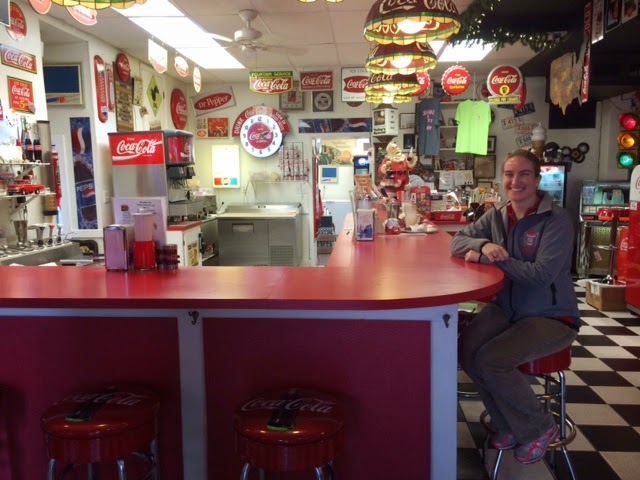
When we enter Schafer's Leather, open since 1867, I am surprisingly greeted by Becky, one of my high school classmates, and we catch up where locals still buy cowboy boots and pick up repaired ones.
Time to walk along the levee, where my Dad's voice laughingly echoes in my head every time with "When you are down by the river, drop in." He always loved the irony in the advertising slogan of the Lafayette.
Time for the tough part of the trip, a visit to Mound Cemetery, yes, that first cemetery I lived across from as a toddler, now the site of Mom and Dad's resting place. We carefully remove the now red and brown grave blanket and brush the dead leaves from the grave stone. I remember all of the times I had walked downtown to visit my mother in her job at the Washington County Health Department from home, walking past the beautiful cemetery with the large conical Moundbuilders Indian Mound in the center, and never dreaming that now, every trip to Marietta would include a visit to place where it is now their final rest.

The cemetery, rimmed by uneven brick streets, is also unique in that many founders of Marietta and former Revolutionary War Soldiers are buried here with a map of the cemetery indicating their names and locations. But for me, the names are the names of my classmates and friends' families. Col William Stacy, Col Buell, Rufus Putnam, Whipple, Bartlett, may be the names on the historic grave markers from the 1700's, but the last names are those the rolls of Washington Elementary School, Marietta Junior High and Marietta High School. I recall being in their homes, working with them at the Marietta Pool, and being in English class with them.
From the cemetery, we park at the corner of 7th and Wooster Streets, my home, or what I will always consider my home. The current owners have left it unchanged now for the past 12 years, the last time my parents lived there, and I am conflicted on whether that is good or bad.
The positive is that it floods our thoughts with so many good memories. My Dad warming up my car in the driveway for me during high school, building the garage door himself, and building the deck with my husband when we were first married. His squirrel feeder that so delighted him is now broken but still there and the eagle is still above the front door. For so long his proud Marine 4th Division insignia was still on the garage door window. It is eerie and beckoning to us as if to say, come in. Mom will be in the kitchen and Dad will be in his chair in the living room, and they will be so thrilled to see us.

But that quickly fades, as the sun does on a cloudy day, and we disappointedly pull away from the curb, knowing that Mom and Dad no longer wait at the window, looking forward to our visit, ready to call my sister and nieces and nephews to get the entire family together as only the bedlam of family time can cause.
Trips to Marietta are still special, for every trip with my daughter is special. Just as she was a little girl, and now a young woman, I am still seeing Marietta through her eyes, and she has always loved these trips, and so have I.
Can we go home again? Yes. Of course we can. But it is different. The sights, sounds, and smells of Marietta in many ways are the same. Sun glistening off the river while small waves lap on the old brick levee.
In the middle of the night, as we slept in the Captain's Room, the night was split by a sound only those who live on the river know, the blaring whistle from the Pilot's house of a barge, rounding the curve at the mouth of the Muskingum as the barge slowly traverses toward the Williamstown Bridge.
At our home on 7th Street, as I lay in my bed, we were often lucky enough to hear those loud whistles as the Delta Queen, the Mississippi Queen, and the American Queen would announce to the entire town that they were docking at the levee. The calliope and Dixieland band played River Boat favorites, and we would rush downtown to the levee to see the travelers disembark and gaze in awe at the magnificence of these Mark Twain era paddle boats
In the Hotel Lafayette this trip, as the barge continues to blast its large whistle to warn all other river travelers, I wake again, and for a short time, I am home. On the river. Where I belong, and where generations of my family have lived, and will live always in my mind.
On Thursday my daughter, now almost 30, and I took one of our many return trips to Marietta, OH, my hometown.
The place where I have memories of every stage of my life. Born in Marietta, living first in a small white clapboard house across the street from Mound Cemetery, one of the most historical cemeteries in the United States.
You see, Marietta is a proud small river town with one of the richest histories of any other USA small town. It was the first established settlement in the Northwest Territory, established in 1788.
In this month's issue, Smithsonian magazine ranks America's Best Small Towns, the Greatest Little Places to Visit This Year, and Marietta is listed 6th.
Highlights that the magazine lists include the watching the coal barges still passing through on the river, the Sternwheeler races in September, and the 19th century working dams and locks that open while riders take pleasure cruises on the Valley Gem, a historic sternwheeler. The downtown is marked by historic buildings with unique shops such as Twisted Sisters, a West Side completely restored that can be accessed by an old railroad trestle crossing the Muskingum River and now a footbridge to yesterday, and a Sweet Corn festival in July.
Situated in the unglaciated part of Ohio, Marietta is built on a series of hills that only locals are comfortable navigating, with narrow streets, frequent road closings due to hill slippages, and sweeping overlooks of both the Ohio and Muskingum River Valleys.
For for me, the 130 miles to Marietta via I-270 to I-70 East. I-70 East to I-77 South, to Exit 1, Marietta, is a trip from a busy and sometimes stressful lifestyle as a high school principal to my childhood, my memories, and a piece of me that no one else knows.
By Zanesville, the world starts to change. And by Cambridge the stress starts to leave my shoulders. By Dexter City, the hills become so familiar and by Lower Salem I know we are only six miles from the exit.
I make the right turn on to Exit 1, merge onto Pike Street, and my head floods with memories. Past my Dad's VFW where he went to "sign the book" every day. Pike turns into Greene Street and rather than turn down 7th Street to my parents home, or former home, Jennifer and I head to the Hotel Lafayette, one of America's finest and oldest hotels. I surprise her with the Captain's Room, the largest room in the hotel, with a wraparound balcony that overlooks the Ohio River dramatically, just a few steps from the levee.
In this present Marietta, Jennifer and I visit all of our favorite restaurants and shops, the Coca-Cola Museum and old diner on the West Side, with the jukebox where 25 cents still gets you two plays and one of the few places real Broughton's ice cream is still served. Teri Ann's boutique also beckons on Front Street and we slowly make our way into all of the quaint shops in buildings that date to the late 1800's and early 1900's.
When we enter Schafer's Leather, open since 1867, I am surprisingly greeted by Becky, one of my high school classmates, and we catch up where locals still buy cowboy boots and pick up repaired ones.
Time to walk along the levee, where my Dad's voice laughingly echoes in my head every time with "When you are down by the river, drop in." He always loved the irony in the advertising slogan of the Lafayette.
Time for the tough part of the trip, a visit to Mound Cemetery, yes, that first cemetery I lived across from as a toddler, now the site of Mom and Dad's resting place. We carefully remove the now red and brown grave blanket and brush the dead leaves from the grave stone. I remember all of the times I had walked downtown to visit my mother in her job at the Washington County Health Department from home, walking past the beautiful cemetery with the large conical Moundbuilders Indian Mound in the center, and never dreaming that now, every trip to Marietta would include a visit to place where it is now their final rest.
The cemetery, rimmed by uneven brick streets, is also unique in that many founders of Marietta and former Revolutionary War Soldiers are buried here with a map of the cemetery indicating their names and locations. But for me, the names are the names of my classmates and friends' families. Col William Stacy, Col Buell, Rufus Putnam, Whipple, Bartlett, may be the names on the historic grave markers from the 1700's, but the last names are those the rolls of Washington Elementary School, Marietta Junior High and Marietta High School. I recall being in their homes, working with them at the Marietta Pool, and being in English class with them.
From the cemetery, we park at the corner of 7th and Wooster Streets, my home, or what I will always consider my home. The current owners have left it unchanged now for the past 12 years, the last time my parents lived there, and I am conflicted on whether that is good or bad.
The positive is that it floods our thoughts with so many good memories. My Dad warming up my car in the driveway for me during high school, building the garage door himself, and building the deck with my husband when we were first married. His squirrel feeder that so delighted him is now broken but still there and the eagle is still above the front door. For so long his proud Marine 4th Division insignia was still on the garage door window. It is eerie and beckoning to us as if to say, come in. Mom will be in the kitchen and Dad will be in his chair in the living room, and they will be so thrilled to see us.
But that quickly fades, as the sun does on a cloudy day, and we disappointedly pull away from the curb, knowing that Mom and Dad no longer wait at the window, looking forward to our visit, ready to call my sister and nieces and nephews to get the entire family together as only the bedlam of family time can cause.
Trips to Marietta are still special, for every trip with my daughter is special. Just as she was a little girl, and now a young woman, I am still seeing Marietta through her eyes, and she has always loved these trips, and so have I.
Can we go home again? Yes. Of course we can. But it is different. The sights, sounds, and smells of Marietta in many ways are the same. Sun glistening off the river while small waves lap on the old brick levee.
In the middle of the night, as we slept in the Captain's Room, the night was split by a sound only those who live on the river know, the blaring whistle from the Pilot's house of a barge, rounding the curve at the mouth of the Muskingum as the barge slowly traverses toward the Williamstown Bridge.
At our home on 7th Street, as I lay in my bed, we were often lucky enough to hear those loud whistles as the Delta Queen, the Mississippi Queen, and the American Queen would announce to the entire town that they were docking at the levee. The calliope and Dixieland band played River Boat favorites, and we would rush downtown to the levee to see the travelers disembark and gaze in awe at the magnificence of these Mark Twain era paddle boats
In the Hotel Lafayette this trip, as the barge continues to blast its large whistle to warn all other river travelers, I wake again, and for a short time, I am home. On the river. Where I belong, and where generations of my family have lived, and will live always in my mind.
Wednesday, March 26, 2014
Dancing for Sales May Make the Difference
I was never a Girl Scout. I remember asking about it, but apparently my older sister had wanted to be a Girl Scout, begged to be a Girl Scout, and my parents relented.
Money was very short in my family and neither of my parents had any experience with Girl Scouting. Apparently a hard sell ensued by both the Girl Scout leader to my parents and by my sister, cherub-faced, blonde-haired and blue-eyed. Surely they could not let their first child ruined for life by missing out on the Girl Scout experience in our small town of Marietta.
I am not sure what happened, but I get the feeling that after purchases of uniform, uniform accessories, patches, dues, outings, supplying treats for meetings, and etc. my sister lost interest in being a Girl Scout, most likely affirming my parents initial fears.
And so, I was never a Girl Scout.
However, I did become a Girl Scout Leader when my daughter expressed interest in being a Girl Scout, right from the beginning as a Daisy. Her Preschool teacher had planted the seed, she remembered that she had to be in kindergarten to be one, and in kindergarten we excitedly traveled to her elementary school to the initial Girl Scout troop organization meeting.
Since I had zero experience in scouting, thanks to my big sister being a Girl Scout dropout, I assumed we would go to the meeting, I would sign her up for the troop, and I would be a Girl Scout Mom.
That was not the case. In fact, there was no troop leader. If you wanted to have a troop, you had to start the troop. Mary, our neighbor, and her daughter Lizzie, one of Jennifer's best friends on the street, had also come to the meeting. We had two smiling, excited desperately want-to-be Daisies. She looked at me and said, "I can do crafts." And I, the former teacher turned Mom at that point, looked at her and said, "I can do kids." And the troop and co-leaders were born.
In fact, it was the start of an amazing Girl Scout mother-daughter journey. Daisies grew into Brownies, who grew into Juniors, who grew into Cadets. We camped, made crafts, baked, and earned hundreds of try-its and badges. The girls even served as ushers at OSU football games and participated in a halftime show with The Ohio State University Marching Band. Who would have thought that only about 6 years later, our daughter would be in The Best Damn Band In The Land.
We bridged every level and largely kept the same 10-12 girls in the troop all of those years. Lifelong friendships for both the parents and the girls. And yes, we sold cookies, thousands of boxes as a troop, earning money for troop outings and activities, and we thought we were pretty good. Until today.
Today I read that that Girl Scout Katie Francis of Oklahoma City sold 18,017 cookies. Whoa! One girl? When I first hear the story on TV, I was mentally disqualifying Katie as someone who used social media or the internet to sell.
Nope. According to the paper, Katie canvasses neighborhoods pulling cookies through snow-covered streets and "breaks into song and dance if necessary."
So that's the key. Dancing and singing to sell cookies-- who would have thought it? Katie broke the old 30-year record for cookies of 18,000 and has a goal of selling 20,000 boxes by the end of March.
I couldn't help but think how many moves does Katie know. I mean-- she is only 11-years-old. And so, I wanted to send her, or anyone else out to break the national cookie-selling record a link to the best-ever dance video. The Evolution of Dance is sure to provide enough moves to anyone, whether you are selling Girl Scout cookies or anything else. So put your dancing shoes on and start selling.
Money was very short in my family and neither of my parents had any experience with Girl Scouting. Apparently a hard sell ensued by both the Girl Scout leader to my parents and by my sister, cherub-faced, blonde-haired and blue-eyed. Surely they could not let their first child ruined for life by missing out on the Girl Scout experience in our small town of Marietta.
I am not sure what happened, but I get the feeling that after purchases of uniform, uniform accessories, patches, dues, outings, supplying treats for meetings, and etc. my sister lost interest in being a Girl Scout, most likely affirming my parents initial fears.
And so, I was never a Girl Scout.
However, I did become a Girl Scout Leader when my daughter expressed interest in being a Girl Scout, right from the beginning as a Daisy. Her Preschool teacher had planted the seed, she remembered that she had to be in kindergarten to be one, and in kindergarten we excitedly traveled to her elementary school to the initial Girl Scout troop organization meeting.
Since I had zero experience in scouting, thanks to my big sister being a Girl Scout dropout, I assumed we would go to the meeting, I would sign her up for the troop, and I would be a Girl Scout Mom.
That was not the case. In fact, there was no troop leader. If you wanted to have a troop, you had to start the troop. Mary, our neighbor, and her daughter Lizzie, one of Jennifer's best friends on the street, had also come to the meeting. We had two smiling, excited desperately want-to-be Daisies. She looked at me and said, "I can do crafts." And I, the former teacher turned Mom at that point, looked at her and said, "I can do kids." And the troop and co-leaders were born.
In fact, it was the start of an amazing Girl Scout mother-daughter journey. Daisies grew into Brownies, who grew into Juniors, who grew into Cadets. We camped, made crafts, baked, and earned hundreds of try-its and badges. The girls even served as ushers at OSU football games and participated in a halftime show with The Ohio State University Marching Band. Who would have thought that only about 6 years later, our daughter would be in The Best Damn Band In The Land.
We bridged every level and largely kept the same 10-12 girls in the troop all of those years. Lifelong friendships for both the parents and the girls. And yes, we sold cookies, thousands of boxes as a troop, earning money for troop outings and activities, and we thought we were pretty good. Until today.
 |
| photo credit: Marit & Toomas Hinnosaar via photopin cc |
Nope. According to the paper, Katie canvasses neighborhoods pulling cookies through snow-covered streets and "breaks into song and dance if necessary."
So that's the key. Dancing and singing to sell cookies-- who would have thought it? Katie broke the old 30-year record for cookies of 18,000 and has a goal of selling 20,000 boxes by the end of March.
I couldn't help but think how many moves does Katie know. I mean-- she is only 11-years-old. And so, I wanted to send her, or anyone else out to break the national cookie-selling record a link to the best-ever dance video. The Evolution of Dance is sure to provide enough moves to anyone, whether you are selling Girl Scout cookies or anything else. So put your dancing shoes on and start selling.
Subscribe to:
Posts (Atom)